Why AI Readiness Should Come Before AI Investment
The decision in front of industrial leaders
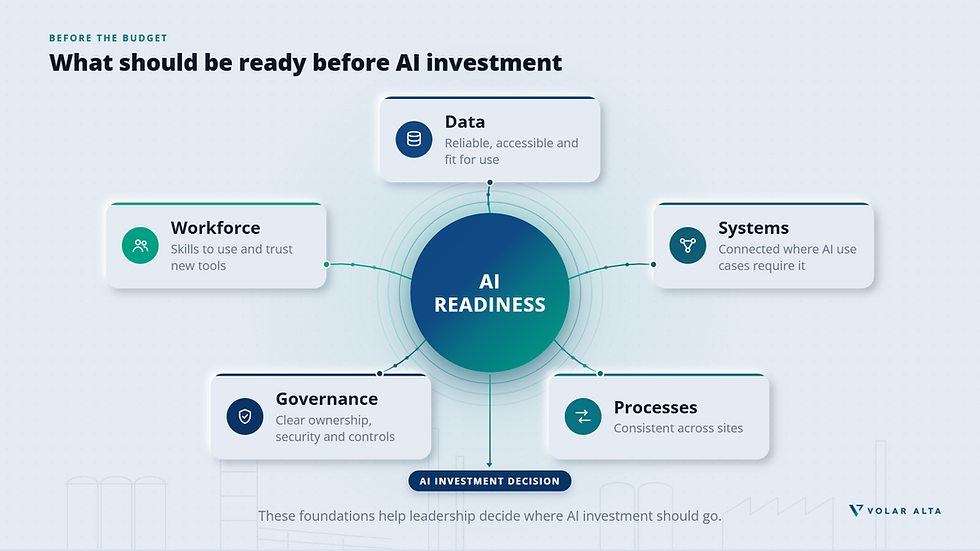
Most industrial leadership teams have moved beyond asking whether AI matters. The question now is where serious investment should go, and whether the organization is ready to turn that investment into an operational capability. For industrial businesses, that question deserves particular attention because AI investment does not happen in isolation. It depends on the organization’s existing data, systems, processes, governance and workforce capabilities.
The gap between AI ambition and organizational preparedness is where many investment decisions become difficult.
What the last two years of AI pilots show
The challenge is moving AI pilots into production and making them work reliably.

This research findings highlight the ongoing challenges organizations face in moving AI pilots into production. Data, processes, governance, skills and ownership all affect whether an AI initiative can move from experimentation into production.
Why asset-heavy operations feel this more
In cement, steel, pharmaceuticals, oil and gas, power and other asset-intensive industries, AI operates alongside systems, sensors, operational processes and records that support production, quality and compliance. Data therefore becomes a critical consideration. Riverbed’s 2025 manufacturing research found that 69% of manufacturing leaders had concerns about the effectiveness of their data for AI.
The challenge also extends beyond technology.
Leadership, management and frontline teams can have different views of the same organizational capability. For example, leadership may view workforce digital capability positively while frontline teams report gaps in recent training. An investment case built on only one view can miss important operational constraints.
Riverbed’s March 2026 manufacturing study found that only 37% of manufacturing organizations considered themselves fully prepared to operationalize AI, while 62% of AI projects remained in pilot or development.
What readiness should establish before budget is committed
Before approving a major AI program, leadership should be able to answer practical questions:
Which priority use cases can current data, systems and processes support?
What is blocking important use cases today?
What would addressing those gaps make possible?
Do leadership, management and frontline teams share the same view?
Is governance appropriate for AI affecting quality, safety or regulated records?
What needs to happen first, and who owns each step?
These answers give an AI investment a measured starting point. They also help leadership explain why certain foundations need attention before additional tools or use cases are funded.
Why Volar Alta built IARA
Volar Alta developed IARA, around a practical leadership need: understanding where an organization stands before major AI and technology commitments are made.
IARA gives executives, technology leaders and operations teams a shared, evidence-based view of readiness, the gaps affecting progress and the priorities that need attention first. The output is designed to support a decision, not simply document a set of observations.
The assessment also establishes a baseline that can be revisited later, allowing leadership to compare progress against the original position.
What changes when readiness comes first
When readiness is established before investment, leadership can connect AI spending to the organization’s actual starting point. That may mean funding data and governance foundations before a new AI application, addressing workforce capability before deployment, or resolving process constraints before expanding a successful pilot.
AI investment will continue to grow across industrial organizations. The more important question is whether each investment starts from an understanding of what the organization can support today.
If your organization is preparing an AI investment case for the next budget cycle, Volar Alta can take your leadership team through what an IARA assessment would cover for your sites and operational priorities.

